PRODUCT 07 · BEESWAX PELLETS
Bulk Beeswax Pellets in White & Yellow Grades
Beeswax pellets are pure beeswax formed into small, free-flowing granules — the form that measures cleanly out of the bag and melts evenly in the pot. Supplied wholesale in white and yellow grades for pillar, moulded and dipped candles, and for blends that need a firmer body.
- Form
- Pellets
- Grade
- 100% pure beeswax
- Colour
- White & yellow
- Samples
- Free, with COA
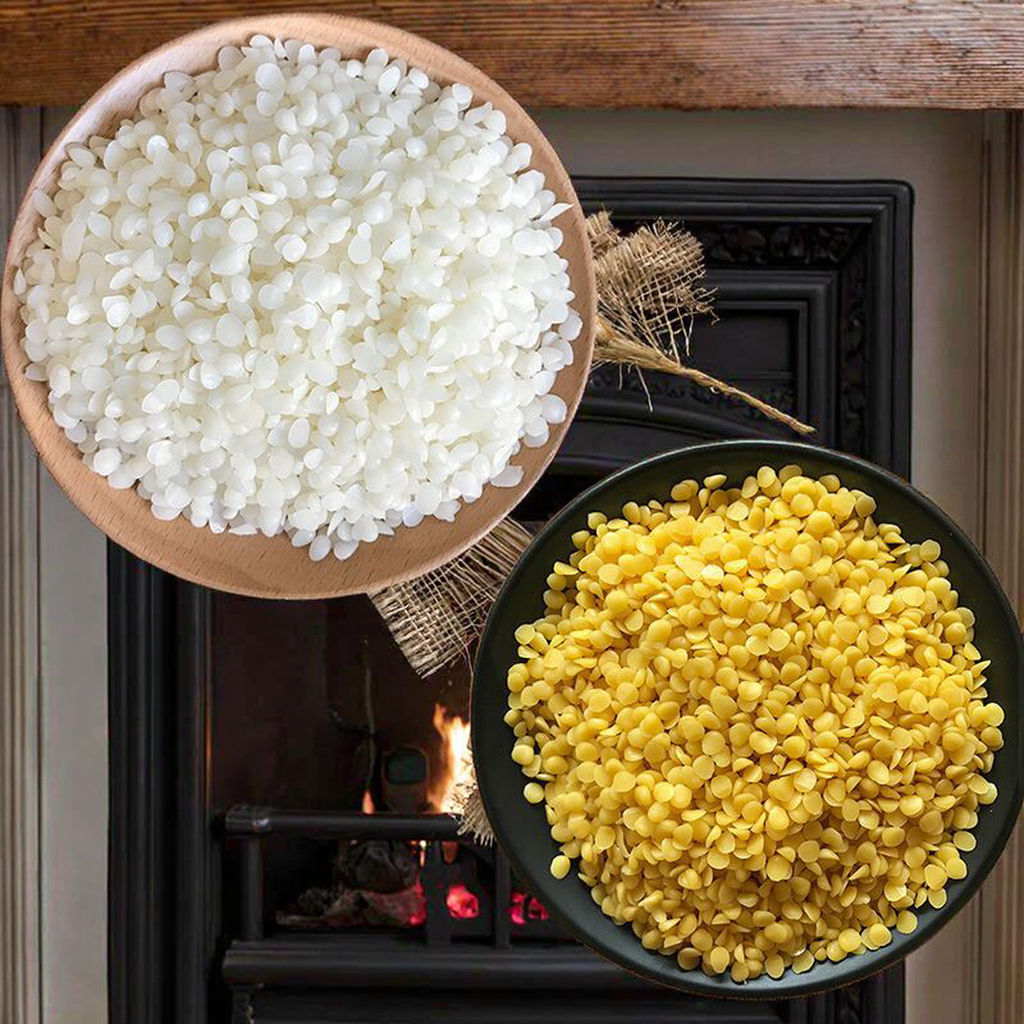
Beeswax pellets are pure beeswax formed into small, free-flowing granules — the form that measures cleanly out of the bag and melts evenly in the pot. POSISION supplies them wholesale in white and yellow grades from our own plant in Henan, China, for pillar candles, moulded and dipped candles, and for brands that add beeswax to a blend to firm the body. This page covers what the two grades are for, where beeswax earns its higher cost in a candle line, and what to check before you commit volume.
What are beeswax pellets, and why pellets?
Beeswax is the wax honeybees build comb from — a natural material with no paraffin in it. In its raw state it arrives as blocks, and blocks are the problem: they have to be chipped or shaved before they melt at an even rate, and every chip is another chance to overheat part of the pot.
Pelletising solves that. The wax is formed into small, uniform granules, so a scoop from the bag is a measured amount, and the pellets melt quickly and evenly because there is no large cold mass in the middle of the pot. For a production line that is the difference between a repeatable formula and a batch that drifts.
The pellet form also travels well. Granules settle into a bag or a box without the air pockets of a chipped block, so the same weight takes less volume — and there is no block to re-shape after a warm container.
White or yellow — what is the difference?
Both grades are pure beeswax from the same source; they differ in how far the wax is filtered and refined.
- Yellow is the less-processed grade and keeps more of the natural tone. It reads warm and honeyed, which is exactly what many natural and gift ranges want to show.
- White is filtered further to take the colour out, which suits ranges where the wax should not tint the finished candle, the label story, or a pale fragrance blend.
The choice is usually made by the finished look, not by the candle's performance. If your range is sold on a natural, unfiltered story, yellow carries it; if you are building pale, clean-toned pillars or want the wax to disappear behind a colour, white is the safer base.
Where does beeswax earn its higher price in a candle line?
Beeswax behaves differently from soy and palm waxes: it sets firmer and holds its shape better as it cools, which is why it shows up in the candle types that need structure rather than a container to hold them.
- Pillars and moulded candles. A firmer body keeps edges crisp and releases from the mould more predictably, which is where pure bee wax candles are traditionally used.
- Taper and dipped candles. Dipping builds a candle layer by layer, and a wax that firms quickly holds the taper that each dip adds.
- Blends. Beeswax is added to softer waxes to firm the candle body. Softer plant waxes can need that help to release cleanly from a mould, which is why a beeswax blend appears in mould-release specifications.
- Ranges that sell on material. Beeswax is one of the few candle materials a customer can recognise by name, which is why it carries a premium in the retail and craft market.
The trade-off is price. Beeswax costs more than soy or palm wax, and buyers almost always run it as a premium line, a blend component, or an accent wax rather than the base of an entry-priced candle. That decision belongs in the RFQ, because the ratio is what changes the quote.
What should you check on the batch documents?
Beeswax is a natural material, so consistency is a document question before it is a candle question. Every batch we ship is QC-checked in-house and leaves with its own certificate of analysis, so ask for the COA for the lot you will actually receive rather than for a generic specification sheet — the two are not the same thing, and the difference is exactly what a buyer needs to see when a blend does not behave as expected.
If you are blending beeswax into your own formula, test on the production lot. Every wax in a blend changes the melt behaviour of the mixture, so a recipe proven on a sample bag should be reconfirmed on the first bulk delivery before it goes to a full run. Our soy wax page describes the same samples-with-COA policy, and the guide to reading a wax COA walks through which lines on the certificate actually matter to a candle maker.
How do MOQ, samples and ordering work?
MOQ is flexible and sized to your pilot rather than to a full container, and it is quoted per project. Free samples of both the white and the yellow grade ship with the COA of their batch, so you can pour and compare the two before you commit volume. Orders under your own brand move through a pre-production sample that you approve first.
Send the RFQ with the grade you want, the candle format you are making and your monthly volume. You get a reply within 24 hours by WhatsApp or phone at +86 133 8403 0866, or by email to kris@posision.com.
Beeswax pellets are a small line that changes what your candle can claim. Send an RFQ for the white and yellow samples with their batch COA, or tell us the format you are building and we will quote the grade that fits it.
FAQ
Beeswax Pellets: buyer questions
Is your beeswax 100% pure?
Yes. The pellets we supply are pure beeswax with no paraffin blended in, in white and yellow grades. The batch COA for the lot you receive documents what was tested.
What is the difference between white and yellow beeswax?
Both are pure beeswax. White is filtered further to take the natural colour out; yellow keeps it. The choice is usually made by the finished look of the candle rather than by how the candle burns.
Can beeswax be used for pillar and mould candles?
Yes — that is where beeswax is traditionally used. It sets firmer than soy or palm wax, so a pillar or moulded candle holds its edges and releases from the mould more predictably.
Does beeswax have to be blended?
Not necessarily. Some makers run pure beeswax for premium pillars and tapers; others blend it into a softer wax to firm the body. Tell us the ratio you have in mind and we quote against it.
What MOQ and samples do you offer?
MOQ is sized to your pilot and quoted per project. Free samples of both the white and the yellow grade ship with the batch COA, so you can pour and compare before you commit volume.
RFQ FORM
Send your beeswax pellets spec
PRODUCT 07 — BEESWAX PELLETS
Send your beeswax pellets spec.
Reply within 24h — with pricing, MOQ, lead time and free samples with COA.