
PRODUCT 15 · CANDLE DYE & PIGMENT
Candle Dye & Wax Pigment for Colouring Bulk Wax
Colour for wax in the two forms makers actually buy: oil-soluble liquid dye measured by the drop for sampling and small runs, and flake pigment for production batches that have to repeat the same shade.
- Liquid dye
- 32 colours · 10 ml
- Pigment
- 34 colours · 1 kg
- Base
- Oil soluble
- Samples
- Free, with COA
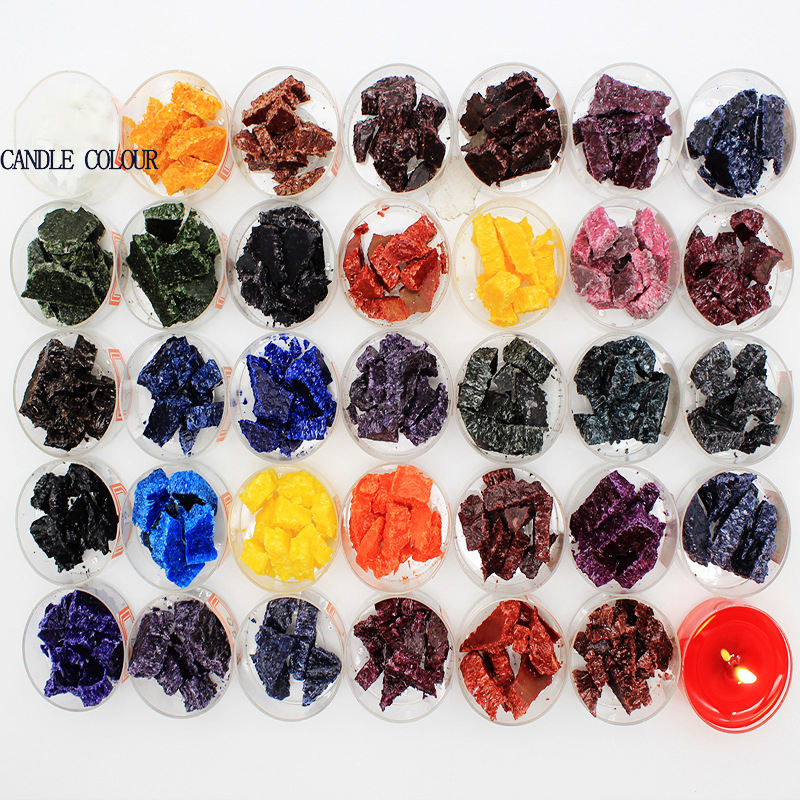
Candle colour is the part of a wax formula that is easiest to get wrong, because the colour you mix is not the colour the customer sees — wax base, fragrance and burn all shift it. POSISION supplies candle colour in the two forms makers actually buy: liquid oil-soluble dye measured by the drop, and flake pigment for batch colouring. Both come from our own plant in Henan, China, and both are matched against an approved sample rather than against a colour name.
Two forms, two jobs
The range is built around the difference between colouring a small pour and colouring a production batch.
- Liquid dye. Supplied in 10 ml bottles across 32 colours, oil-soluble and unscented. It disperses fast and is measured by the drop, which makes it the form for sample pours, small studio runs and re-tinting a base you have already made. Our dye bottle listing is the one to look at for the colour range.
- Flake pigment. Supplied in 1 kg bags across 34 colours, as flake that carries the colour into the wax as it melts. This is the production form: a weighed amount goes into the melter with the wax, and the batch comes out the same colour every time.
The practical rule is that liquid dye is for iterating and flake pigment is for repeating. Studios commonly buy dye first, settle the shade, then move the winning colour to pigment for bulk.
Oil-soluble, and why that matters
Both forms are oil-soluble, which is the only base that works in wax. A water-based colour will sit in the melt as droplets and either streak the candle or fall out of suspension, and it will not disperse at all in a granule product like sand wax or the colored candle sand fill.
Oil-soluble colour also carries into soap, which is why the dye listing covers both candle and soap makers. If you produce a matching candle-and-soap set, one colour library covers both lines.
How colour behaves in wax
Four things move a shade after you have mixed it, and knowing them saves a rework cycle.
- The wax base. The same dye reads differently in soy, in paraffin and in a coconut blend, because the base has its own tint and its own opacity. Always mix the colour in the base you are actually selling.
- Fragrance. Some oils tint the wax warm or yellow, so a colour approved before the fragrance went in can shift once it has.
- Load and depth. Colour reads darker in a deep fill of a narrow jar than in a wide shallow one, so judge the shade in the final container rather than in a mixing cup.
- Burn. A candle that burns for an hour is not the same colour it was cold, particularly at the melt pool, where colour can separate and gather at the edge.
None of these are defects — they are the reason colour has to be approved on a poured sample of the real formula in the real container.
Getting a colour you can repeat
Repeatability is a documentation problem rather than a mixing problem, and it is solved in three steps.
First, approve a physical sample — a poured candle in the final container, not a swatch on paper — and keep it as the reference. Second, record the colour code and the amount used against the wax weight, so the next batch starts from a number rather than from memory. Third, hold every following batch to the approved reference, which is what our in-house QC does before a colour order is packed.
If the colour is going into a granule product, the same three steps apply with one addition: the colour has to be in the granule rather than on it, or the boundary between two layers reads as a muddy seam as soon as the fill settles. Our colored candle sand page covers that in more detail.
What about MOQ, samples and ordering?
MOQ is quoted per project against your volume rather than as a blanket number, and colour is supplied by the unit you buy it in — 10 ml bottles for dye, 1 kg bags for pigment. Free samples ship with the COA of their batch, so the colour you test is the colour you order. Every batch is QC-checked in-house and matched against the approved sample before packing.
Send the RFQ with the shade you are aiming at, the wax base you are colouring and your volume. You get a reply within 24 hours by WhatsApp or phone at +86 133 8403 0866, or by email to kris@posision.com.
Colour sells the candle before the wick is ever lit, so approve it on a poured sample. Send an RFQ with your base wax and target shade, or ask for the free colour samples with the batch COA.
FAQ
Candle Dye & Pigment: buyer questions
Liquid dye or flake pigment — which should I buy?
Liquid dye is for iterating: it disperses fast and is measured by the drop, so it suits sample pours and small studio runs. Flake pigment is for repeating: a weighed amount goes into the melter and the production batch comes out the same colour every time. Studios usually settle the shade in dye and then move it to pigment for bulk.
Why does the colour have to be oil soluble?
Because wax is an oil. A water-based colour sits in the melt as droplets and either streaks the candle or falls out of suspension entirely, and it will not disperse at all into a granule product like sand wax or coloured candle sand.
Will the colour look the same as the swatch?
Not necessarily, and that is normal. The wax base carries its own tint, fragrance can warm the shade, colour reads darker in a deep narrow fill than a wide shallow one, and the melt pool shifts again while the candle burns. Approve the colour on a poured candle in the final container, not on a swatch.
How do I keep a colour repeatable across batches?
Approve a physical sample — a poured candle in the real container — and keep it as the reference. Record the colour code and the amount used against the wax weight, then hold every following batch to that reference. Our in-house QC does that check before a colour order is packed.
What MOQ and samples do you offer?
MOQ is quoted per project against your volume, and colour ships by the unit you buy it in — 10 ml bottles for dye, 1 kg bags for pigment. Free samples ship with the batch COA, so the colour you test is the colour you order.
RFQ FORM
Send your candle dye & pigment spec
PRODUCT 15 — CANDLE DYE & PIGMENT
Send your candle dye & pigment spec.
Reply within 24h — with pricing, MOQ, lead time and free samples with COA.