
PRODUCT 16 · SILICONE CANDLE MOLDS
Reusable Silicone Candle Molds for Cast & 3D Candles
Reusable silicone molds for cast candles — bubble, geometric and 3D shapes that release with their detail intact and no release agent, supplied alongside the wax and wick the same candle needs.
- Material
- Silicone
- Shapes
- Bubble · geometric · 3D
- Reuse
- Reusable
- Samples
- On request
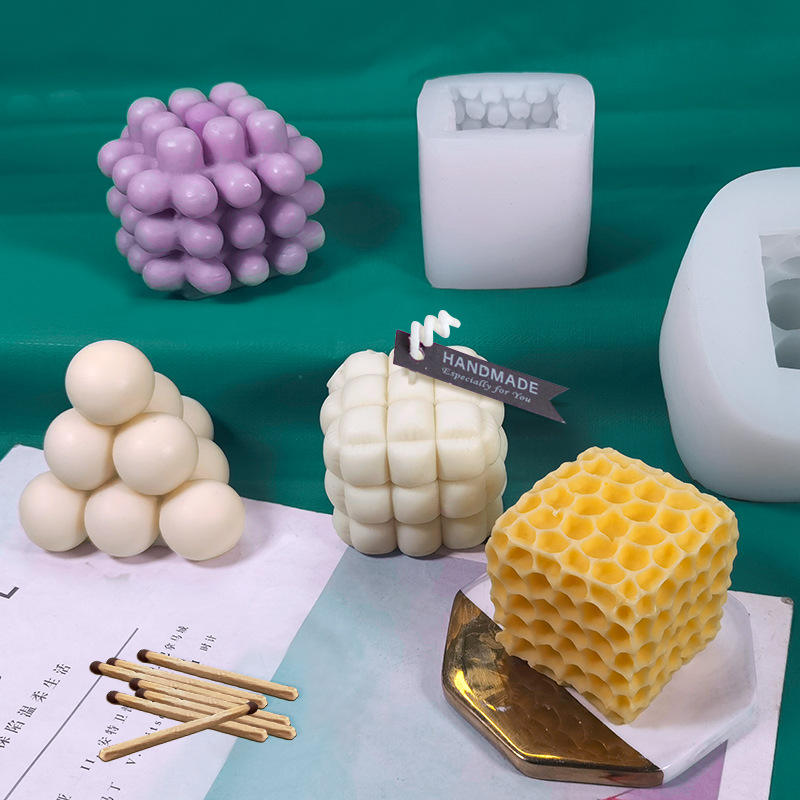
Silicone candle molds are what let a candle take a shape no jar can give it — a bubble cube, a honeycomb block, a sculpted figure that releases from the mould with its detail intact. POSISION supplies reusable silicone molds in bulk from our own plant in Henan, China, alongside the wax and the cotton wick the same candle needs, so the shape, the wax and the wick are specified together instead of in three orders.
Why silicone rather than a rigid mould
A cast candle has to come out of its mould without breaking, and that is the whole argument for silicone.
Silicone flexes. You peel it away from the set wax instead of pulling the wax out of it, which means undercut shapes — ball clusters, honeycomb cells, figures with a waist — come away clean. A rigid mould can only release shapes that taper in one direction. Silicone also releases without a release agent, which removes a step and a consumable from the line, and it survives repeated pours.
The trade-off is rigidity, and it shows up in wall thickness. A thin silicone mould bows when it is filled, so the candle comes out slightly different every time. The moulds worth buying have thick walls and a flat base, because that is what holds the shape steady while the wax sets.
The shapes in the range
The format in our photography is a white block mould with spherical cavities, casting the bubble-cube candle, alongside moulds for a ball-stack, a cube and a honeycomb block. The cast candles shown in that photograph are the output of the same set.
The range covers three families of shape, and each sells to a different buyer.
- Geometric and bubble shapes. Cube clusters, ball stacks and honeycomb blocks. These are the shapes that carry a modern retail or gift range and photograph well on a marketplace listing.
- Textured and relief shapes. Where the surface detail is the product — patterns, honeycomb cells, sculpted relief.
- Novelty and 3D figures. Sculpted shapes for gifting, seasonal ranges and craft sellers.
Because the mould decides the silhouette and the label does not, a single wax and wick specification can carry a whole series of shapes. That is why mould ranges usually sell as a set rather than as a single piece.
How a cast candle is made
Four steps, and only the third one is where most of the failures happen.
- Prepare the mould. Clean, dry and at room temperature. A cold mould sets the wax surface too fast and leaves the detail short.
- Pour at the right temperature. Too hot and the wax shrinks visibly away from the cavity as it cools; too cool and it sets before it has filled the fine detail.
- Top up the shrink. Cast wax sinks as it sets, so a mould is filled slightly proud and topped up once or twice. Skipping this is what leaves a hollow crater in the base of the candle.
- Release and finish. Flex the mould away from the candle, then trim the base and fit the wick. A cast candle that leans usually leans because the base was not trimmed flat.
The wax you cast with matters as much as the mould. Firm bases such as beeswax hold an edge and release more predictably, while softer container waxes can slump in a mould. Our beeswax pellet page covers that side of the decision.
What to check before ordering in volume
Three checks on a sample mould, and all three are done before a bulk order rather than after it.
- Cast one in your own wax. Detail fill, shrink and release behaviour are all specific to the wax you use, so test with the base you intend to sell.
- Cast five in a row. A mould that delivers one good candle and then starts to bow or tear is not production-ready, and repetition is the only way to see it.
- Weigh the output. The cast weight per candle decides your fill claim and your cost per unit, and it varies with the wax and the top-up.
Every order ships from a plant that also supplies the wax and the wick, so a mould order can be quoted with the rest of the candle in one place.
What about MOQ, samples and ordering?
MOQ is quoted per project against your volume rather than as a blanket number, and molds are supplied in bulk, so a range is priced per shape rather than per single piece. Sample molds are available so you can cast in your own wax before committing to a set.
Send the RFQ with the shapes you want, the wax base you cast with and your volume. You get a reply within 24 hours by WhatsApp or phone at +86 133 8403 0866, or by email to kris@posision.com.
A mould is judged on the second cast, not the first. Send an RFQ with your target shapes, or ask for the sample mould and cast it in your own wax before you order the range.
FAQ
Silicone Candle Molds: buyer questions
Why use silicone instead of a rigid mold?
Because silicone flexes, so you peel it away from the set wax instead of pulling the wax out of it. That is what lets undercut shapes — ball clusters, honeycomb cells, sculpted figures — release cleanly, and it removes the need for a release agent.
What shapes does the range cover?
Three families: bubble and geometric shapes such as the cube and ball-stack candles in our photography, textured and relief shapes where the surface detail is the product, and novelty or 3D figures for gifting and seasonal ranges.
Why did my cast candle come out with a hollow base?
Almost always because the mold was not topped up. Cast wax sinks as it sets, so a mold is filled slightly proud and topped up once or twice while it cools. Skipping that step leaves the crater.
Which wax should I cast with?
Firmer bases hold an edge and release more predictably, which is why beeswax is traditional for molded and pillar work. Softer container waxes can slump in a mold, so test with the base you intend to sell. Our beeswax pellet line covers that decision.
What MOQ and samples do you offer?
MOQ is quoted per project against your volume rather than as a blanket number, and molds are supplied in bulk so a series is priced per shape. Sample molds are available so you can cast in your own wax before ordering the set.
RFQ FORM
Send your silicone candle molds spec
PRODUCT 16 — SILICONE CANDLE MOLDS
Send your silicone candle molds spec.
Reply within 24h — with pricing, MOQ, lead time and free samples with COA.